
Ecommerce Fulfillment
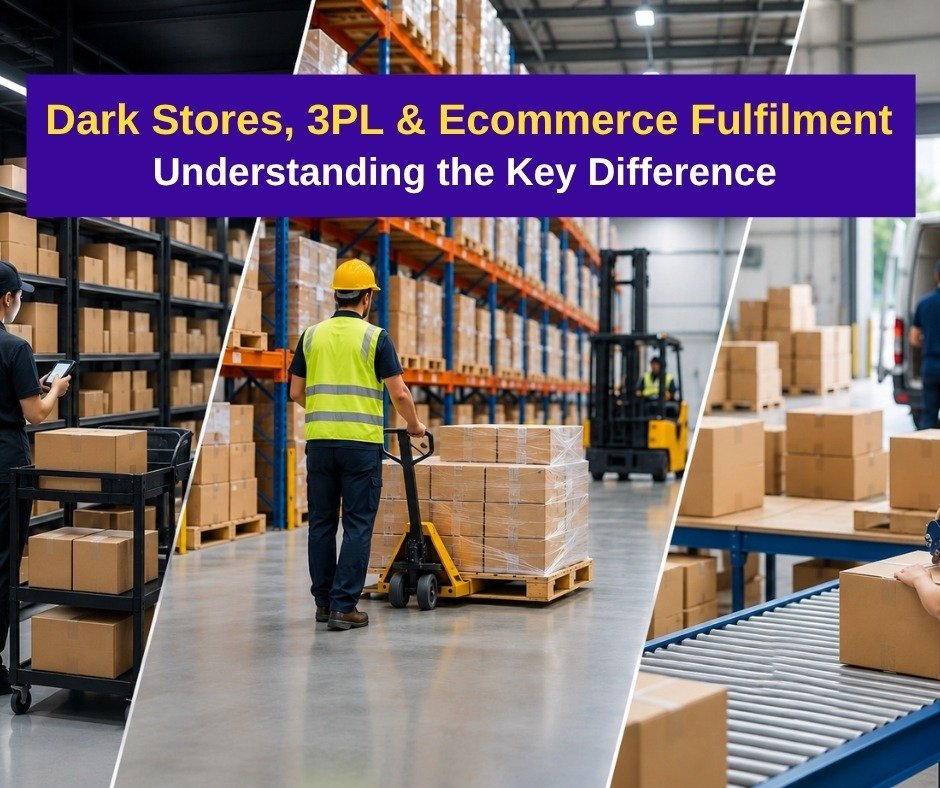
Dark Stores vs 3PL vs Ecommerce Fulfilment.
The growth of online shopping and quick commerce has changed how businesses store products, process orders, and deliver goods to customers. Consumers increasingly expect faster deliveries, accurate orders, and real-time updates. To meet these expectations, businesses need efficient inventory management, reliable warehousing, and well-organized logistics operations.
Three important concepts in this evolving supply chain are dark stores, third-party logistics (3PL), and e-commerce fulfilment. Understanding Dark Stores vs 3PL and e-commerce fulfilment can help businesses choose the right operational model according to their products, customer locations, order volumes, and delivery requirements.
In this article, we will explore the differences between dark stores, 3PL, and e-commerce fulfilment, their benefits, and how businesses can choose the right warehousing solution.
What Is a Dark Store -
A dark store is a retail or distribution facility designed primarily to fulfil online orders rather than serve walk-in customers. It typically stocks products close to the customers who are expected to order them, allowing businesses to prepare orders quickly and arrange local deliveries.
Dark stores are particularly common in quick commerce and online grocery businesses. They may stock groceries, household essentials, personal care products, packaged foods, and other frequently ordered items. Unlike a traditional retail store, a dark store focuses on inventory availability, order picking, packing, and dispatch.
Key Benefits of Dark Stores :
Faster local deliveries: Products are stored closer to customers, supporting shorter delivery routes.
Better inventory visibility: Digital systems can help track product availability and stock movement.
Efficient order processing: Dedicated picking and packing areas help organize online orders.
Improved customer convenience: Customers can receive frequently purchased items without visiting a physical store.
Demand-based inventory planning: Businesses can stock products according to local purchasing patterns.
What Is Third-Party Logistics (3PL) -
Third-party logistics, commonly known as 3PL, is a business model in which a company outsources selected logistics activities to an external service provider. 3PL Logistics services are particularly useful for businesses that need storage infrastructure and logistics support without investing in and managing every operational resource themselves. Benefits of Third-Party Logistics –
Reduced infrastructure investment
Businesses may avoid the expense of leasing and equipping their own warehouse, purchasing certain equipment, and building an in-house logistics team.
Flexible storage requirements
Outsourcing can help businesses adjust their storage arrangements as inventory levels and business requirements change, subject to the provider’s capacity and contract terms.
More organized inventory management
Suitable warehouse processes and inventory systems can improve stock visibility, reduce handling errors, and support better planning.
Support for business expansion
Businesses entering new markets may use third-party logistics to access storage and distribution infrastructure without immediately building their own facilities.
What Is E-Commerce Fulfilment -
E-commerce fulfilment is the complete operational process of receiving, storing, picking, packing, and dispatching products sold through online channels. Depending on the business model, it may also include delivery coordination, returns processing, and inventory reporting. Fulfilment can be managed in different ways. An online seller may process orders from its own warehouse, use a dedicated fulfilment centre, outsource the process to a 3PL provider, or operate through a combination of these models.
Inventory receiving
Products arriving from manufacturers or suppliers are checked and recorded before being placed in storage.
Product storage
Inventory is organized so that staff can locate products efficiently and maintain accurate stock records
Order processing
Customer orders are received through online marketplaces, websites, or other sales channels and passed to the fulfilment operation.
Picking and packing
The required products are picked, checked, and packed appropriately for dispatch.
Shipping and Return Management
Orders are handed over to the selected transport or delivery partner according to the delivery arrangement. Where included in the operation, returned products are inspected and either returned to saleable inventory or handled according to the business’s returns policy.
How to Choose the Right Warehousing and Fulfilment Model -
Understand Your Delivery Requirements
If your business promises rapid delivery within a small geographical area, a strategically located dark store may be appropriate. If you serve customers across multiple cities or regions, a central warehouse combined with suitable transport arrangements may be more practical.
Evaluate Your Inventory Volume
Businesses managing large quantities of inventory may prioritize storage capacity and efficient bulk handling. Companies processing frequent small orders may need dedicated picking and packing processes.
Compare In-House and Outsourced Operations
Managing a warehouse independently offers greater direct control but requires investment in infrastructure, staff, equipment, and systems. A 3PL arrangement can provide access to external logistics resources, depending on the service agreement.
Check Technology and Inventory Visibility
Inventory management systems, order tracking, and clear reporting procedures can help businesses maintain accurate records. Confirm which systems and reports a warehouse or logistics provider actually offers.
Consider Future Growth
Select a model that can accommodate realistic changes in inventory, order volumes, and distribution requirements. Review capacity limits, contract terms, and the cost of scaling operations before making a commitment.
How Robin Enterprises Can Support Warehousing Requirements -
Dark stores, third-party logistics, and e-commerce fulfilment serve different but connected purposes in modern supply chains. Dark stores focus on preparing online orders close to local customers, 3PL providers manage outsourced logistics activities, and e-commerce fulfilment covers the operational process of handling online orders.
Understanding Dark Stores vs 3PL helps businesses identify the right model according to their delivery expectations, inventory requirements, and business goals. While some companies may benefit from dedicated dark stores, others may prefer conventional warehousing, outsourced logistics, or a combination of these approaches.
For businesses serving Mumbai and surrounding markets, e-commerce warehousing in Bhiwandi can be a practical option to consider for storage and distribution requirements. Robin Enterprises provides comprehensive 3PL warehousing and e-commerce fulfillment in Bhiwandi for businesses looking to organize their storage and logistics operations, supporting the requirements of FMCG companies, retailers, wholesalers, and e-commerce businesses. By choosing suitable warehousing solutions, businesses can improve inventory management, streamline stock handling, and support their distribution needs as they grow.
Looking for Ecommerce Warehouse in Bhiwandi?
Robin Enterprises can be a warehousing partner to consider for your business requirements. Contact Robin Enterprises to discuss your storage needs and explore suitable Warehousing solutions in Bhiwandi for your operations.
📞 Call: +91 9167261110
📧 Email: info@robinenterprises.co.in
🌐 Visit: robinenterprises.co.in
Your Trusted Warehousing Partner !
Frequently Asked Questions (FAQs)
What is the difference between dark stores and 3PL?
A dark store is a facility designed primarily for online order preparation, often close to local customers. Third-party logistics (3PL) is a model in which an external provider manages selected logistics activities, such as warehousing, handling, and dispatch.
What is e-commerce fulfilment?
E-commerce fulfilment is the process of receiving, storing, picking, packing, and dispatching products sold online. Depending on the arrangement, it may also include delivery coordination and returns processing.
Is a dark store the same as a warehouse?
No. A traditional warehouse often focuses on storage and broader distribution, while a dark store is generally designed to prepare online orders quickly for local delivery. Both can be part of the same supply chain.
Why consider e-commerce warehousing in Bhiwandi?
Bhiwandi is an established warehousing and logistics hub near Mumbai. Businesses serving Mumbai, Thane, and nearby markets can evaluate its location, transport connectivity, available facilities, and operating costs. Robin Enterprises is an option for businesses exploring warehousing solutions in Bhiwandi.
How do I choose the right warehouse in Bhiwandi?
Compare storage capacity, location, security, infrastructure, inventory handling, dispatch procedures, pricing, and service terms. Robin Enterprises can be considered by FMCG companies, retailers, wholesalers, and e-commerce businesses looking for a suitable warehouse in Bhiwandi, based on their specific storage requirements.
Related Posts

Why E-Commerce Brands Are Shifting to 3PLs for Smarter Inventory Management
Ecommerce Fulfillment December 26, 2025 Robin Enterprises The Real Reasons E-Commerce Leaders Are Choosing 3PL in Bhiwandi. The rapid growth of e-commerce has completely transformed…