
Warehousing
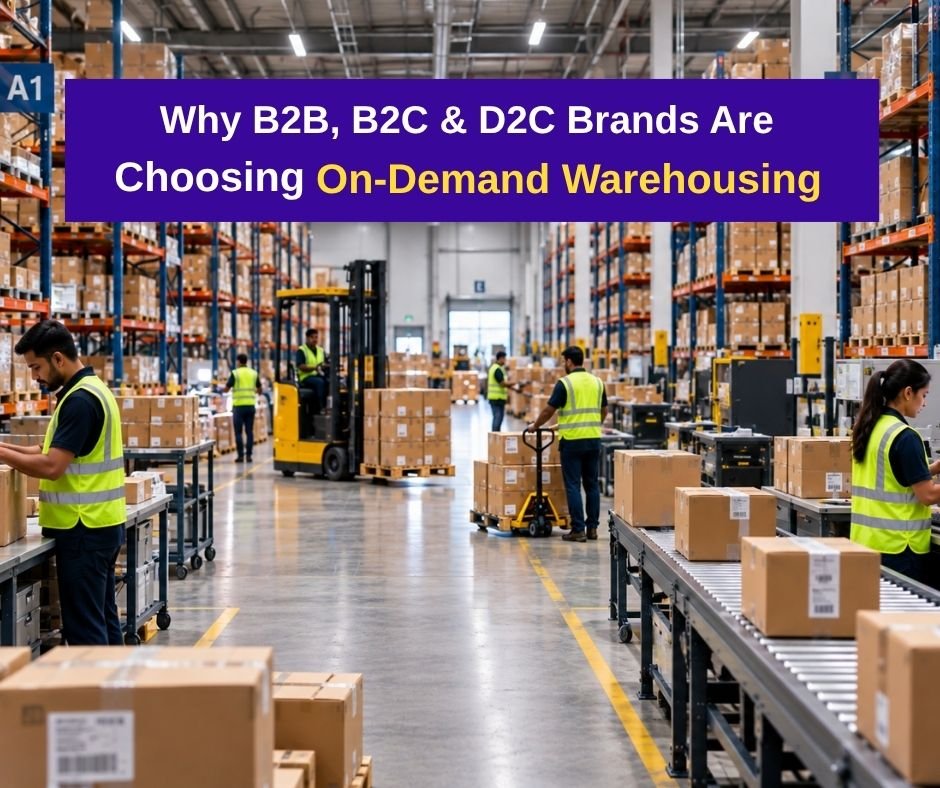
On-Demand Warehousing Services in Bhiwandi.
For growing B2B, B2C, and D2C brands, this lack of flexibility can become a major challenge. Seasonal demand, new market expansion, product launches, e-commerce growth, and unpredictable order volumes make it difficult to determine exactly how much warehouse space a business will need. This is where on-demand warehousing is becoming increasingly valuable.
Instead of investing in permanent warehouse infrastructure or paying for unused capacity, businesses can access flexible storage and fulfillment infrastructure according to their actual requirements. From temporary inventory storage to complete warehousing and distribution services, the model allows brands to scale their logistics operations with greater flexibility.
Whether a company sells directly to businesses, consumers, retailers, marketplaces, or through its own online store, on-demand warehousing can help create a more responsive and cost-efficient supply chain.
What Is On-Demand Warehousing -
On-demand warehousing is a flexible logistics model that allows businesses to access warehouse space and related services based on their current inventory and operational requirements. Unlike traditional warehousing arrangements that may involve fixed space and longer commitments, on-demand warehouse services can provide businesses with greater flexibility to increase or decrease storage capacity as demand changes.
Depending on the service provider, businesses may also access additional solutions such as:
- Inventory storage and management
- Inbound and outbound handling
- Pick and pack services
- B2B and B2C order fulfillment
- E-commerce fulfillment
- Distribution and dispatch
- Packaging and labeling
- Returns management
- Transportation coordination
- Inventory tracking and reporting
7 Key Benefits of On-Demand Warehousing -
Greater Flexibility to Scale Warehouse Space
Inventory requirements rarely remain constant throughout the year. A business may require significantly more warehouse space during festive seasons, promotional campaigns, product launches, or periods of rapid growth. With a traditional fixed-capacity warehouse, companies generally face two problems. If they lease too much space, they pay for capacity they do not use. If they lease too little space, they may struggle when inventory increases.
Flexible warehousing solutions provide an alternative by allowing businesses to align warehouse capacity more closely with changing requirements.
Lower Warehousing and Infrastructure Costs
Businesses may need to invest in racks, material handling equipment, warehouse management systems, security, manpower, utilities, maintenance, packaging stations, fire and safety systems, and operational management. These expenses can significantly increase the overall cost of logistics.
Using third-party warehousing services allows businesses to access existing warehouse infrastructure without having to build every capability internally.
Faster Expansion Into New Markets
Geographical expansion is one of the most important use cases for on-demand warehousing. D2C brand currently fulfills all orders from one location but begins receiving significant demand from customers in another region. Continuing to ship every order from the original warehouse could increase transportation costs and delivery times.
For B2B businesses, strategically located warehouses can similarly improve distribution to dealers, distributors, retailers, and institutional customers.
Better Support for B2B, B2C and D2C Fulfillment
B2B warehousing typically involves larger quantities, bulk orders, pallets, cartons, distributor shipments, retailer replenishment, and scheduled dispatches. Efficient inventory organization and outbound planning become particularly important when managing large-volume orders.
B2C warehousing generally requires processing a much larger number of smaller orders. Products must be picked, packed, labeled, sorted, and dispatched efficiently. Accuracy becomes critical because even a small picking error can result in customer complaints, replacements, or returns.
D2C fulfillment operation may involve individual order processing, branded packaging, product bundling, promotional inserts, fast dispatch, and returns handling. An experienced warehousing partner can help businesses manage these different workflows within a structured fulfillment operation.
Improved Inventory Management
Without organized inventory management, companies can face problems such as excess stock, stockouts, misplaced inventory, inaccurate order processing, and delayed dispatches.
A well-managed on-demand warehouse should provide structured processes for receiving, storing, tracking, picking, and dispatching products. Better inventory organization helps businesses understand what stock is available and where it is located.
Better Management of Seasonal Demand
Many businesses experience dramatic seasonal fluctuations. Fashion, electronics, gifting, consumer goods, festive products, and e-commerce categories can experience sudden increases in inventory and order volumes during specific periods.
On-demand warehouse services allow companies to access additional capacity when required instead of maintaining excess space throughout the year.
E-Commerce Fulfillment Capabilities
E-commerce fulfillment requires speed, accuracy, and coordination. When hundreds or thousands of orders are processed, small inefficiencies at any stage can create significant delays.
Professional ecommerce warehousing and fulfillment operations use defined processes to handle these activities more efficiently.
Who Should Consider On-Demand Warehousing -
Experience Seasonal Inventory Fluctuations
Manage seasonal demand efficiently with flexible warehouse space that can expand or reduce according to changing inventory volumes.
Are Expanding Into New Cities or Markets
Enter new cities and markets faster with strategically located warehousing solutions without investing in your own storage infrastructure.
Need Additional Warehouse Capacity Quickly
Access additional warehouse space quickly during sudden inventory growth, peak seasons, large orders, or unexpected increases in demand.
Sell Through Multiple B2B, B2C & D2C Channels
Manage inventory and fulfillment across B2B, B2C, and D2C sales channels through a flexible and well-organized warehousing network.
Are Experiencing Rapid Order Growth
Scale warehouse and fulfillment operations smoothly as order volumes increase without being limited by existing storage capacity or resources.
Need Professional Ecommerce Fulfillment
Improve ecommerce fulfillment with efficient inventory storage, order picking, packing, labeling, processing, and timely dispatch services.
Build a More Flexible Supply Chain with Robin Enterprises -
The right choice depends on your business requirements. Mumbai may work for businesses that need a warehouse inside the city and require direct city-level access. However, for most businesses including ecommerce companies, manufacturers, distributors, and retailers, Bhiwandi offers a more practical and cost-effective warehousing solution.
For B2B, B2C, and D2C brands, choosing the right warehousing model can directly influence inventory efficiency, fulfillment speed, distribution capabilities, and the ability to scale.
On-demand warehousing provides businesses with the flexibility to respond to changing inventory levels, seasonal demand, growing order volumes, and expansion into new markets without immediately building extensive warehouse infrastructure of their own.
If your business needs reliable warehousing, inventory management, B2B and B2C fulfillment, ecommerce fulfillment, order processing, distribution, or other logistics support, Robin Enterprises can provide flexible warehousing solutions tailored to your operational requirements.
With the right warehousing and fulfillment partner, businesses can spend less time managing logistics complexity and more time focusing on growth—while building a supply chain capable of supporting B2B, B2C, and D2C operations at scale.
Looking for On-Demand Warehousing in Bhiwandi?
Robin Enterprises provides best On-Demand Warehousing services in Bhiwandi. A trusted warehousing partner takes the burden of storage, inventory management, and order fulfillment off your shoulders, allowing you to focus on growing your business.
📞 Call: +91 9167261110
📧 Email: info@robinenterprises.co.in
🌐 Visit: robinenterprises.co.in
Your Trusted Warehousing Partner !
Frequently Asked Questions (FAQs)
What is on-demand warehousing?
On-demand warehousing is a flexible storage model that allows businesses to access warehouse space and related services based on their current requirements without investing in permanent warehouse infrastructure.
How does on-demand warehousing benefit B2B, B2C and D2C brands?
It helps B2B, B2C and D2C brands scale storage capacity, manage changing inventory levels, reduce fixed costs, improve order fulfillment, and expand into new markets more efficiently.
Is on-demand warehousing suitable for ecommerce businesses?
Yes. On-demand warehousing is ideal for ecommerce businesses that need flexible inventory storage, picking, packing, labeling, order processing, dispatch, and scalable ecommerce fulfillment services.
Can on-demand warehousing help manage seasonal demand?
Yes. Businesses can increase warehouse capacity during festive seasons, sales campaigns, product launches, or demand spikes and reduce their storage requirements when inventory levels return to normal.
How do I choose the right on-demand warehousing partner?
Look for a provider with strategic warehouse locations, reliable inventory management, scalable storage capacity, efficient fulfillment processes, experienced manpower, and strong distribution support. Robin Enterprises provides flexible warehousing and fulfillment solutions for businesses looking to streamline their storage, order processing, and distribution operations.
Related Posts
Why Professional Warehousing Matters More Than Ever
Warehousing May 15, 2026 Robin Enterprises Top Professional Warehousing In Bhiwandi. In the modern business world, speed, efficiency, and customer satisfaction have become the foundation…