
Warehousing
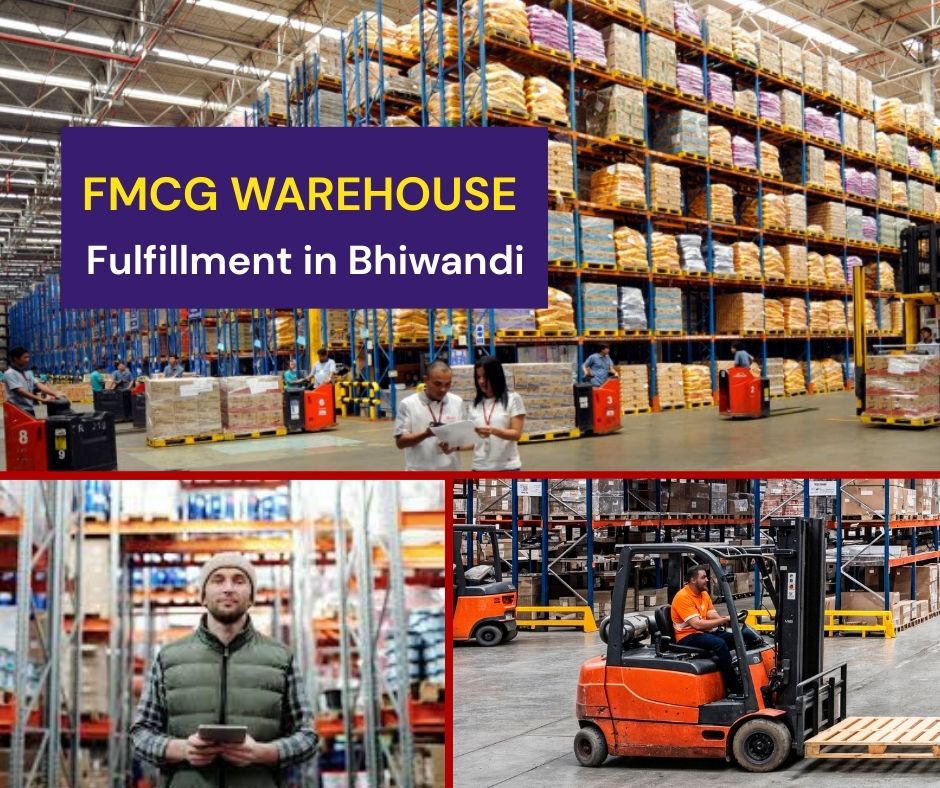
FMCG Warehouse Fulfillment in Bhiwandi.
The rise of e-commerce has completely reshaped consumer expectations around speed, convenience, visibility, and personalized delivery experiences. Over the past few years, online retail giants have set new benchmarks for how quickly products should move from a warehouse shelf to a customer’s doorstep. This shift has forced every sector — from electronics to fashion — to rethink how fulfillment is planned, executed, and optimized. The efficiency, agility, and tech-driven visibility that power online retail can significantly improve FMCG warehousing, distribution, demand planning, and customer experience. From automated picking and granular inventory tracking to last-mile optimization and flexible warehousing solutions, the strategies used by leading e-commerce players can help FMCG brands reduce costs, avoid stockouts, improve delivery speed, and respond faster to market changes.
In the sections below, we break down the most important takeaways — covering everything from warehouse design and order processing to inventory accuracy, demand forecasting, packaging, and last-mile excellence.
Powerful E-Commerce Practices FMCG Companies Can Leverage for Growth -
Speed Is the New Normal: Optimize for Faster Fulfillment
E-commerce platforms thrive because they reduce order-to-delivery time dramatically. Consumers now expect same-day and next-day delivery, even for essential goods.
What FMCG Brands Can Learn –
Adopt hub-and-spoke fulfillment locations to reduce last-mile distance.
Use micro-warehousing or dark stores for high-demand regions.
Implement real-time picking and packing systems instead of batch processing to improve agility.
Use technology to predict peak demand so stockouts don’t affect service levels.
Technology-Led Visibility Across the Supply Chain
E-commerce giants rely heavily on digital tracking systems, giving customers visibility from order placement to delivery.
What FMCG Brands Can Learn –
Introduce real-time inventory tracking across factories, warehouses, and distributors.
Use Warehouse Management Systems (WMS) with live dashboards to reduce delays.
Track SKU movement at a granular level to minimize wastage, expiry, and pilferage.
Integrate IoT sensors for cold-chain FMCG to maintain product integrity.
Data-Driven Decision Making for Predictive Demand
E-commerce fulfillment runs on data intelligence — browsing behavior, buying trends, seasonality, and geo-demand patterns.
What FMCG Brands Can Learn –
Use AI-based demand forecasting to predict product demand at a regional level.
Optimize distribution routes based on real consumption patterns.
Analyse order velocity to maintain ideal safety stock levels.
Utilize point-of-sale (POS) data from modern trade & Kirana-tech platforms.
Personalization of Delivery & Packaging
E-commerce brands deliver exceptional customer experiences by personalizing packaging, delivery speed, and messaging.
What FMCG Brands Can Learn –
Offer region-specific SKUs, bundles, or sizes based on consumption habits.
Optimize packaging to reduce freight cost while maintaining brand presence.
Use QR codes for personalized promotions, loyalty programs, or authenticity checks.
Introduce subscription models for frequently used FMCG items.
Flexible Warehousing and Scalability
E-commerce businesses scale seamlessly during festive seasons, sales events, or monthly peaks.
What FMCG Brands Can Learn –
Choose flexible warehousing solutions that expand during peak months.
Adopt 3PL partners for variable storage, instead of fixed-cost setups.
Use cross-docking for seasonal SKUs to reduce dwell time in warehouses.
Improve SKU-level flow by adopting e-commerce style ABC categorization + fast lanes.
Last-Mile Efficiency and Distribution Optimization
The last-mile is where e-commerce excels — routing, tracking, and delivery optimization are highly sophisticated.
What FMCG Brands Can Learn –
Use route-optimization tools for distributor and retailer delivery.
Introduce digital POD (Proof of Delivery) for accuracy and transparency.
Combine retail and e-commerce deliveries to reduce cost per kilometer.
Work with regional fulfillment hubs to ensure quicker replenishment.
Reverse Logistics & Returns Handling
E-commerce models handle returns systematically, minimizing loss and improving customer trust.
What FMCG Brands Can Learn –
Implement structured return-to-warehouse and return-to-supplier processes.
Follow FEFO (First Expiry First Out) across all return touchpoints.
Use digital tracking for return inventory to avoid leakage.
For damaged/near-expiry products, adopt centralized QC zones like e-commerce hubs.
Automation and Process Standardization
E-commerce fulfillment centres use automation for speed, accuracy, and reliability.
What FMCG Brands Can Learn –
Introduce automated conveyor systems in high-volume warehouses.
Use handheld scanners or RFID for faster picking.
Implement SOPs that mirror e-commerce picking efficiency.
- Automate replenishment from storage to processing zones.
Direct-to-Consumer (D2C) Enablement
E-commerce brands excel because they directly engage with consumers.
What FMCG Brands Can Learn –
Launch D2C channels to test new SKUs or limited editions.
Use fulfillment partners that support D2C + B2B hybrid warehousing.
Collect consumer feedback in real time for rapid product improvement.
Sustainability & Cost Efficiency
Many e-commerce companies are moving towards eco-friendly and cost-efficient operations.
What FMCG Brands Can Learn –
Use lightweight packaging to reduce freight expenses.
Implement energy-efficient warehouses with solar rooftops.
Reduce wastage through better demand prediction and reverse logistics.
Power Your FMCG Growth with Advanced Fulfillment in Bhiwandi -
E-commerce fulfillment has set a new benchmark for speed, accuracy, personalization, and scalability. FMCG companies—traditionally dependent on large distributors and slow-moving logistics—can transform their operational efficiency by adopting these models. By embracing technology, automation, flexible warehousing, real-time data, and customer-centric distribution, FMCG brands can unlock a more resilient, agile, and future-ready supply chain.
Choose a location that gives you reach, speed, and cost efficiency.
Choose a fulfillment partner that understands FMCG deeply and delivers with precision.
👉 Partner with Robin Enterprises Warehouse & Logistics — one of Bhiwandi’s trusted names for optimized FMCG tech-enabled fulfillment and warehousing in Bhiwandi.
What You Get with Robin Enterprises –
✔️ Smart & scalable FMCG-ready warehousing
✔️ Tech-enabled WMS for real-time visibility
✔️ Faster distribution across Mumbai, Thane, Navi Mumbai & Pan-India
✔️ SKU-level accuracy for high-volume FMCG operations
✔️ End-to-end B2B, B2C & D2C fulfillment support
Let’s Build a Faster, Smarter FMCG Supply Chain Together
📞 Call: +91 9167261110
📧 Email: info@robinenterprises.co.in
🌐 Visit: robinenterprises.co.in
Your Trusted Warehousing Partner !
Related Posts

Why 2026 Is the Year to Upgrade Your Warehousing & Fulfillment Model
Warehousing January 5, 2026 Robin Enterprises Best Warehousing & Fulfillment Solutions in Bhiwandi. In an era of rising customer expectations and complex distribution networks, warehousing…