
Warehousing
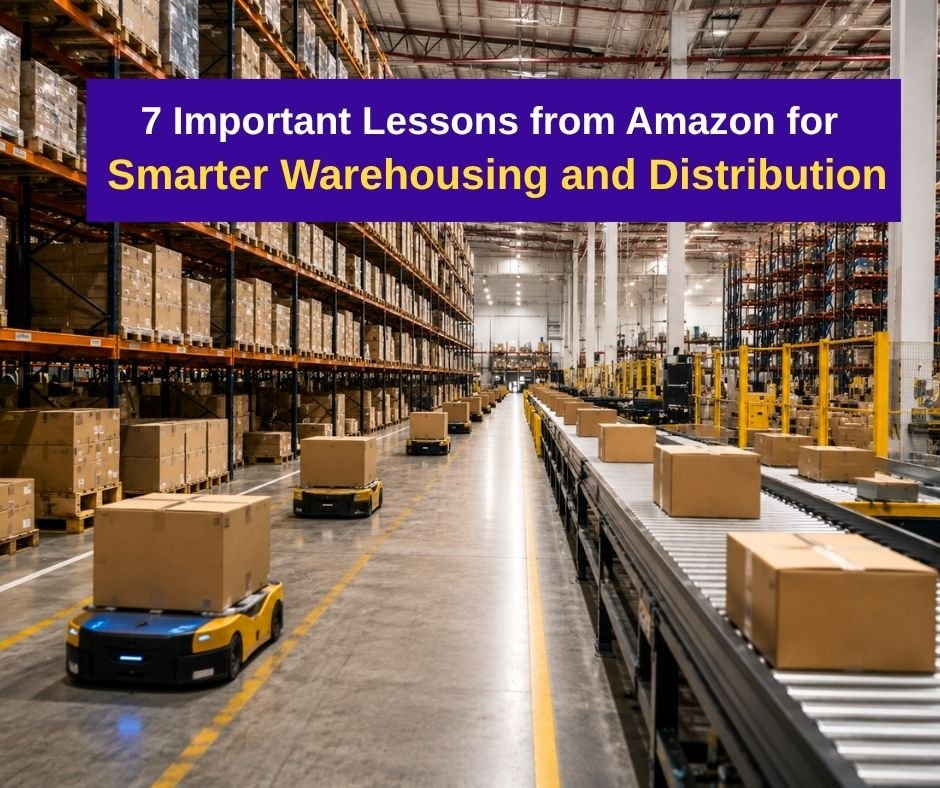
A complete guide for smart warehousing.
Modern businesses operate in an environment where customers expect fast deliveries, accurate orders, real-time updates, and reliable service. Meeting these expectations requires more than simply having a warehouse and shipping products when orders arrive. Businesses need smarter systems for inventory management, warehouse operations, order fulfillment, distribution management, and supply chain efficiency.
One company that has significantly influenced how businesses think about logistics is Amazon. Its global scale may be impossible for many companies to replicate, but the principles behind its operations offer valuable insights for businesses of all sizes.
These Amazon Warehousing Lessons are not about copying Amazon’s infrastructure or investing in expensive automation overnight. Instead, they are about understanding how efficient processes, technology, inventory visibility, strategic warehouse locations, and continuous improvement can create a stronger warehousing and distribution system.
Amazon’s 7 Key Lessons for Warehousing and Distribution -
Put Customers First Expectations
One of the biggest lessons from Amazon’s approach is that warehouse operations should ultimately support the customer experience. Customers generally do not think about storage racks, picking processes, inventory systems, or transportation routes. They care about receiving the correct product, in good condition, and within the promised delivery timeframe. This means that every part of the order fulfillment process should be designed around reliability and speed.
On the other hand, Bhiwandi is located near Mumbai and Thane, making it a preferred logistics hub for businesses that need easy access to the Mumbai Metropolitan Region (MMR).
For businesses, this can include:
- Improving order accuracy
- Reducing picking and packing errors
- Processing orders faster
- Maintaining accurate inventory information
- Providing realistic delivery timelines
- Minimizing damaged or incorrect shipments
Choose Strategic Warehouse Locations
Warehouse location plays a major role in distribution management and delivery performance. Amazon’s logistics model demonstrates the importance of placing inventory closer to areas where customer demand exists. Shorter distances between inventory and customers can reduce transportation time and help businesses improve delivery efficiency. Businesses do not necessarily need multiple warehouses to benefit from this lesson. Even a growing company can evaluate where its customers are located and make better decisions about inventory placement and distribution.
Important factors to consider include:
- Customer demand by region
- Shipping costs
- Delivery timelines
- Transportation infrastructure
- Availability of logistics partners
- Growth potential in specific markets
Improve Inventory Management
A warehouse cannot operate efficiently without accurate inventory information. One of the most important Amazon Warehousing Lessons is the value of maintaining strong visibility over inventory. Businesses need to know what products they have, where those products are located, and when they need to replenish stock.
Poor inventory management can create several problems, including
- Stockouts
- Overstocking
- Delayed order fulfillment
- Incorrect shipments
- Wasted warehouse space
- Higher carrying costs
Modern businesses should aim for real-time or near-real-time inventory visibility wherever possible. This becomes particularly important for companies with multiple sales channels, warehouses, or fulfillment partners.
Standardize Warehouse Processes
As order volumes grow, informal processes can quickly become inefficient. Amazon’s large-scale operations highlight the importance of creating repeatable and standardized workflows. Businesses can apply the same principle to their own warehouse operations, regardless of size.
Clear processes should be established for activities such as:
- Receiving incoming inventory
- Inspecting goods
- Storing products
- Picking orders
- Packing shipments
- Labeling packages
- Dispatching orders
- Handling returns
Use Technology Wisely
Technology is one of the most visible aspects of Amazon’s logistics operations, but the real lesson is not simply to automate everything. Technology should solve specific operational problems. A small or medium-sized business does not necessarily need advanced robotics to improve its warehouse. Even basic warehouse management software, barcode systems, inventory tracking tools, and automated reporting can significantly improve performance.
Useful technologies for smarter warehousing may include:
- Warehouse management systems
- Barcode or QR code scanning
- Inventory tracking software
- Order management platforms
- Demand forecasting tools
- Automated reporting
- Route optimization systems
Optimize Warehouse Design
Poorly organized storage can increase employee travel time, create congestion, and slow down the entire order fulfillment process. Businesses can improve warehouse efficiency by analyzing how products move through the facility. Fast-moving products, for example, should generally be positioned in easily accessible locations. Products that are frequently purchased together may also be stored closer to each other when operationally practical.
A well-designed warehouse considers:
- Product demand
- Picking frequency
- Storage requirements
- Employee movement
- Equipment access
- Safety requirements
- Future growth
Focus on Continuous Improvement
Customer expectations change. Order volumes increase. Product categories expand. Transportation costs fluctuate. New technologies become available. As a result, businesses should regularly review their distribution strategies for businesses rather than assuming that existing systems will remain effective forever.
Continuous improvement can involve monitoring key performance indicators such as:
- Order accuracy
- Order processing time
- Inventory accuracy
- Picking productivity
- On-time dispatch rate
- Delivery performance
- Return rates
How Small and Medium Businesses Can Apply These Lessons -
Improve Inventory Accuracy
Start by ensuring that inventory records match actual stock levels. Regular inventory checks and barcode systems can significantly reduce errors.
Organize Products Based on Demand
Place frequently ordered products in locations that are easier and faster to access.
Standardize the Order Fulfillment Process
Create clear procedures for receiving, picking, packing, and dispatching orders.
Measure Warehouse Performance
Track a few important metrics rather than relying only on assumptions about warehouse performance.
Use Technology Where It Creates Value
Choose tools based on actual operational requirements. A simple inventory management platform may provide more immediate value than expensive automation.
Review Distribution Costs
Analyze transportation costs, delivery timelines, and customer locations to identify opportunities for better distribution planning. By taking a gradual approach, businesses can improve warehousing and distribution without making unnecessary investments.
Smart Warehousing and Distribution Provider in Bhiwandi -
The right choice depends on your business requirements. Mumbai may work for businesses that need a warehouse inside the city and require direct city-level access. However, for most businesses including ecommerce companies, manufacturers, distributors, and retailers, Bhiwandi offers a more practical and cost-effective warehousing solution.
The most important lesson from Amazon’s approach is that efficient warehousing and distribution are built on strong processes, accurate inventory management, strategic planning, technology, and continuous improvement. Businesses do not need to operate at Amazon’s scale to apply these principles. Even small and growing businesses can improve efficiency by adopting smarter warehouse and distribution strategies.
At Robin Enterprises, we help businesses build more efficient and reliable logistics operations through professional warehousing, inventory management, order fulfillment, and distribution solutions. Our services are designed to support businesses at different stages of growth while helping improve operational efficiency, streamline fulfillment, and ensure smoother movement of goods.
Whether you need support with ecommerce warehousing, inventory management, order fulfillment, or distribution, Robin Enterprises can help create solutions that match your business requirements. With the right infrastructure, processes, and logistics support, businesses can improve customer experience while building a stronger and more scalable supply chain.
Looking for Warehousing & Distribution in Bhiwandi?
Robin Enterprises provides best Warehousing services in Bhiwandi. A trusted warehousing partner takes the burden of storage, inventory management, and order fulfillment off your shoulders, allowing you to focus on growing your business.
📞 Call: +91 9167261110
📧 Email: info@robinenterprises.co.in
🌐 Visit: robinenterprises.co.in
Your Trusted Warehousing Partner !
Frequently Asked Questions (FAQs)
What can businesses learn from Amazon’s warehousing strategy?
Businesses can learn the importance of accurate inventory management, efficient warehouse layouts, technology-driven operations, faster order fulfillment, and customer-focused distribution. These practices can help improve overall supply chain efficiency.
How does smart warehousing improve order fulfillment?
Smart warehousing improves product organization, inventory visibility, picking accuracy, and processing speed. This helps businesses reduce errors, dispatch orders faster, and provide a more reliable customer experience.
Why is inventory management important in warehousing and distribution?
Effective inventory management helps businesses maintain accurate stock levels, prevent overstocking and stockouts, reduce storage costs, and ensure products are available when customers place orders.
How can businesses improve their warehousing and distribution operations?
Businesses can improve operations by optimizing warehouse layouts, standardizing processes, using inventory management technology, tracking performance, and working with an experienced warehousing and distribution partner.
How can Robin Enterprises support warehousing and distribution needs?
Robin Enterprises provides warehousing, inventory management, order fulfillment, and distribution solutions to help businesses streamline logistics operations. Our services support efficient product storage, smoother fulfillment, reliable distribution, and scalable supply chain operations.
Related Posts
Why Professional Warehousing Matters More Than Ever
Warehousing May 15, 2026 Robin Enterprises Top Professional Warehousing In Bhiwandi. In the modern business world, speed, efficiency, and customer satisfaction have become the foundation…